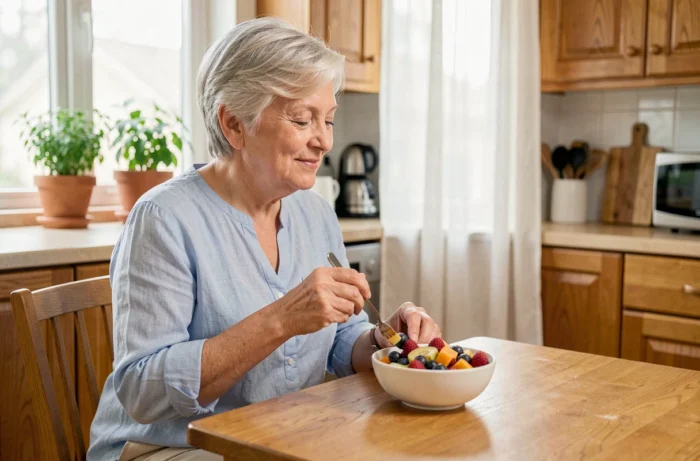
After 60, the body does not always signal its needs in the same way. The sensation of thirst diminishes, fatigue sets in more quickly after moderate exertion, and certain nutritional deficiencies can go unnoticed for months. Improving the health and well-being of seniors on a daily basis relies less on major changes and more on precise adjustments, repeated every day.
Malnutrition in Seniors: A Often Underestimated Risk
Have you ever noticed that an elderly person eats less without complaining of hunger? This phenomenon has a name: early satiety. With age, the stomach sends a fullness signal earlier in the meal. The problem is that nutritional needs do not decrease with age. They remain stable, or even increase for certain nutrients.
The Montaigne Institute emphasizes that malnutrition can affect people who do not appear to be ill. A gradual loss of muscle mass weakens balance, reduces mobility, and increases the risk of falls. To prevent this, it is essential to maintain a sufficient intake of protein, in the form of eggs, fish, meat, or legumes, at least once a day.
Three dietary habits make a daily difference for seniors who wish to take care of their health and well-being with Santé Bien-Être sustainably:
- Divide meals into three main servings supplemented by one or two snacks (yogurt, fruit, a handful of nuts) to compensate for early satiety.
- Drink regularly without waiting for thirst, as the sensation of thirst significantly diminishes after 65. Water, herbal teas, soups: everything counts.
- Monitor weight once a month to detect any unintentional loss, a warning sign to report to the doctor.
ICOPE Assessment: Identifying Fragility Before It Sets In
Prevention in seniors often boils down to monitoring chronic diseases: blood pressure, blood sugar, cholesterol. The ICOPE program from the WHO offers a different approach. Instead of only monitoring pathologies, it assesses six functional areas: mobility, memory, nutrition, vision, hearing, and mood.
The practical interest is concrete. A slight hearing loss, for example, can go unnoticed for years. However, it leads to gradual social withdrawal, decreased cognitive stimulation, and sometimes a depressive state. Early identification of a functional difficulty allows for action before the loss of autonomy.
This assessment does not replace traditional medical follow-up. It complements it by drawing attention to weak signals that neither the patient nor the doctor typically look for during a regular consultation. Requesting such an assessment from your primary care physician or at a prevention center is a first step towards better-supported aging.
Vaccination for Seniors: Protections Still Too Neglected
Seasonal flu is one of the known vaccines after 65. But other vaccinations remain underutilized. Public Health France indicates in 2025 that the protection of seniors remains uneven and calls for better promotion of vaccines against shingles and pneumococcal infections.
Shingles, in particular, affects a significant proportion of people over 60. The pain it causes can last for months, sometimes years (post-herpetic neuralgia). The shingles vaccine reduces the risk of prolonged pain, a direct benefit for daily quality of life.
Why are these vaccines still under-offered? Often because medical consultations focus on the main complaint. Vaccinations take a back seat. Keeping an updated list of your vaccinations and showing it at each medical appointment helps ensure nothing is forgotten.
Schedule to Check with Your Doctor
- Seasonal flu: annual booster every autumn.
- Shingles: check eligibility starting at 65.
- Pneumococcus: recommended for those at respiratory or immunological risk.
- Covid-19: boosters according to current recommendations.
Adapted Physical Activity and Social Connection: Two Indissociable Levers
Walking for thirty minutes a day is a common recommendation. It remains valid but incomplete. What truly protects seniors is the combination of three types of exercise: endurance (walking, swimming), muscle strengthening (exercises with resistance bands, climbing stairs), and balance training, which directly prevents falls.
Muscle strengthening deserves special attention. After 60, muscle mass naturally decreases. Without regular stimulation, this loss accelerates and weakens the entire body. Two short sessions per week are enough to slow the process.
Move Together Rather Than Alone
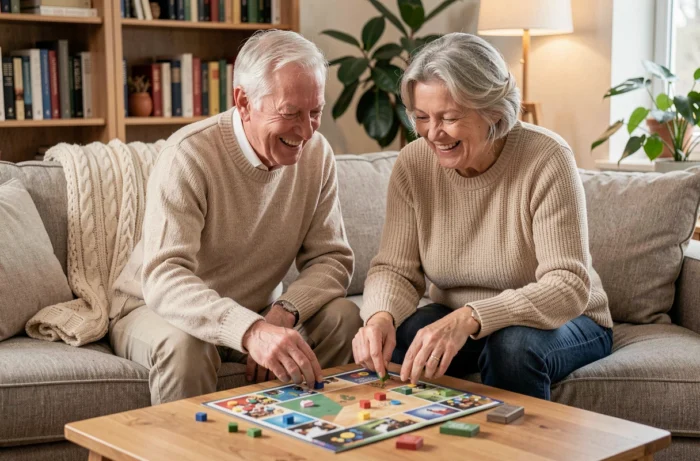
Physical activity practiced in a group adds a dimension that solitary exercise does not cover: social connection. Isolation affects a significant portion of people over 60 in France. The Petits Frères des Pauvres regularly document this phenomenon through their barometer on the loneliness of the elderly.
Social connection impacts mental health as much as physical health. Participating in a gentle gym class, joining a walking group, or simply sharing a coffee after exercise creates regular meetings that structure the week and maintain the desire to go out.
Seniors’ Sleep: Adapt Habits Rather Than Endure Them
Sleep changes with age. Deep sleep phases shorten, nighttime awakenings increase, and falling asleep occurs earlier in the evening. These changes are normal, but they do not mean one should accept poor sleep.
Two common mistakes worsen the situation. The first: going to bed too early out of boredom or fatigue, leading to waking up at three or four in the morning. The second: compensating with long naps during the day, which further fragment nighttime sleep.
A twenty-minute nap in the early afternoon improves alertness without disrupting nighttime sleep. Beyond thirty minutes, it competes with deep sleep at night. Maintaining regular bedtimes and wake-up times, even on weekends, remains the most effective lever for stabilizing the circadian rhythm.
Caring for one’s health after 60 does not require a complete overhaul. Monitoring diet to avoid malnutrition, checking vaccinations, varying exercises, cultivating human contact, and respecting sleep rhythms: these five adjustments, applied regularly, preserve autonomy much longer than one might imagine.