
A lime tree with low branches rubbing against the roof, a privet hedge spilling onto the sidewalk, an old apple tree whose center no longer gets any light: every pruning job in the garden calls for the right tool and, sometimes, the decision not to tackle it yourself. Before comparing pruning shears and saws, the first question to ask is whether the job is safe and feasible: working height, the presence of nests, and your level of training.
Postpone or hire a professional: assess the job before choosing a tool
We often think about equipment first. In practice, the order should be different. Article L. 411-1 of the French Environmental Code prohibits the destruction of protected species’ nests. If a hedge or tree contains an occupied nest or there is visible nesting activity, pruning in that area must be postponed, whatever tools you have available.
For homeowners, there is no general nationwide ban on trimming hedges on set dates. The obligations linked to CAP cross-compliance apply to farmers, not private gardens. However, local rules may also apply, including municipal orders and subdivision regulations. Check before getting out the chainsaw.
The other factor is height. Working from a ladder with a powered cutting tool at heights above three or four meters carries a serious risk of falls and injury. Manufacturers also describe some pruning chainsaws as intended only for professionals trained in tree pruning. When a job is beyond our abilities, we can compare the features of tools suited to our actual level of experience at elagueuse-warrior.com.
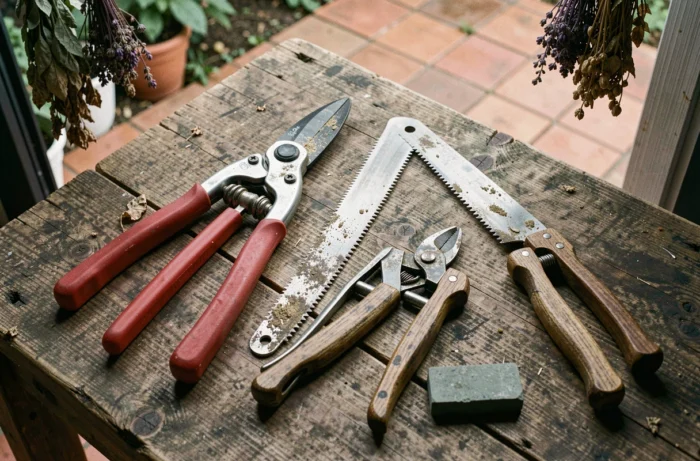
Pruning shears, loppers, saw: match the tool to the branch diameter
Branch diameter remains the most reliable selection criterion. Each tool is designed for a particular cutting range, and forcing an undersized tool damages both the wood and the blade.
- Pruning shears (manual or electric) are suitable for shoots and small branches up to about 25 mm in diameter. Bypass shears make a clean cut on green, soft wood, while anvil models are better suited to dry or dead wood.
- Loppers take over for branches measuring 30 to 50 mm. Their long handles provide leverage and reduce effort, but they require you to work within arm’s reach or from the ground using a pole pruner.
- Pruning saws, whether handheld or pole-mounted, are used for branches over 50 mm. Their specialized teeth (often triple-ground) cut on the pull stroke, not the push stroke, making them easier to use at height.
For garden shrubs such as roses, forsythias, and hydrangeas, pruning shears are usually enough. Loppers come in handy as soon as you start pruning the framework of a fruit tree or an ornamental tree with substantial main branches.
Battery-powered pruning shears: who are they for?
Battery-powered pruning shears reduce fatigue when doing repetitive pruning, especially in an orchard or along a long shrub hedge. They maintain a consistent cut even after several hours of use. The higher purchase price is worthwhile if you regularly prune large quantities.
One point rarely covered in buying guides is how easy the tool is to repair. The French Ministry for Ecological Transition states that the repair bonus may apply to gardening equipment repaired by QualiRépar-certified professionals. Before buying, check that spare parts are available and that there is an authorized repairer nearby, rather than comparing only price and battery life.
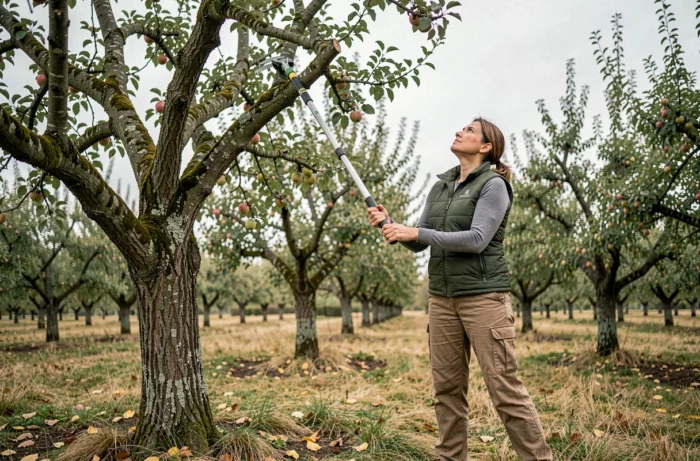
Pruning chainsaw: not a tool to use without proper training
A pruning chainsaw is not just a large pair of pruning shears. It is a powerful cutting tool designed for thick branches or work in the tree canopy. Manufacturer product specifications clearly state that some models are intended for trained users and warn of the risk of serious injury without proper training.
If you have never used a chainsaw, hiring a professional arborist for work at height is the safest choice. The cost of a one-off service is often less than the cost of a household accident, not to mention the investment in the tool itself and personal protective equipment (a helmet with visor, cut-resistant gloves, and chainsaw chaps).
Gas or battery-powered chainsaw?
Gas-powered models offer unlimited runtime and consistent power. They are suitable for large rural jobs where noise is not an issue. Battery-powered models are lighter, quieter, and easy to start, but their runtime varies depending on the type of wood and the intensity of the work. For a medium-sized garden in a residential area, a battery-powered model will meet most needs.
Pruning tool maintenance: three steps that extend its life
A poorly maintained tool tears the wood instead of cutting cleanly through it. This slows the tree’s healing process and increases the risk of fungal infection.
- Clean the blade after each session with a cloth soaked in denatured alcohol. This helps prevent the spread of disease from one tree to another, especially among fruit trees susceptible to canker or brown rot.
- Sharpen regularly. Pruning shears can be sharpened with a whetstone, while a chainsaw chain requires a round file suited to its pitch. A sharp blade requires less force and makes a cleaner cut.
- Oil the joints and chain. For manual pruning shears, a drop of oil on the pivot after cleaning is enough. On a chainsaw, the chain is lubricated continuously, and the oil level should be checked before each use.
These steps take just a few minutes. They extend the life of your tools by several seasons and ensure clean cuts that benefit both the tree and the gardener.
Choose pruning equipment based on the job, not the catalog. Branch diameter, working height, the presence of nesting wildlife, and your experience level: these four factors point you toward the right tool—or the right professional.