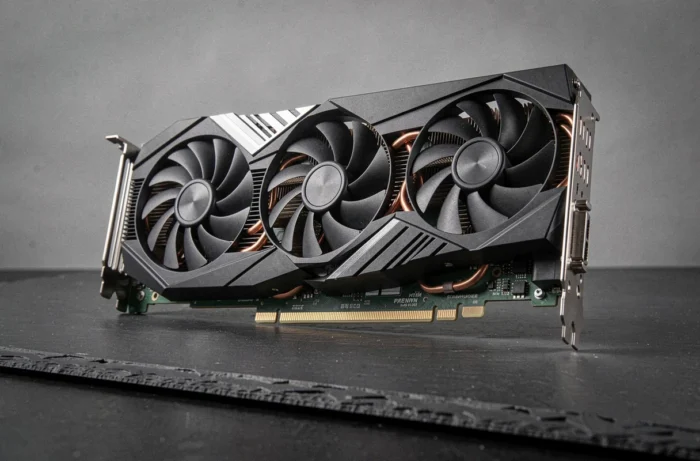
NVIDIA has not officially confirmed the name, specifications, or release date of a GeForce RTX 60 series. Rumors have been circulating for several months, fueled by conflicting leaks and the announcement of the Vera Rubin platform for data centers. The gaming graphics card market is therefore still relying on speculation, at a time when the RTX 5000 series is still relatively new and memory supplies remain constrained.
RTX 6000 and GeForce RTX 60: naming confusion clouds the debate
Before discussing release dates or specifications, it’s worth clarifying one point of terminology. NVIDIA already sells an RTX 6000 Ada Generation, a professional graphics card designed for workstations. This product has nothing to do with a hypothetical gaming-focused GeForce RTX 60 series.
Articles with headlines about the “RTX 6000” often conflate these two products. When a leaker mentions an “RTX 6090” or “RTX 6080,” they’re referring to a consumer GeForce generation that NVIDIA has not yet officially announced. This distinction changes how all the rumors should be interpreted: no specifications published for the professional lineup can predict the features of a future gaming card.
To keep up with the latest information on the RTX 6000 release date, it’s important to keep this distinction in mind, or risk comparing products aimed at different audiences.

Rubin architecture: what NVIDIA has confirmed and what remains speculation
NVIDIA has introduced Vera Rubin as an artificial intelligence platform designed to operate across entire racks in data centers. The announcement was immediately interpreted as confirmation that the Rubin architecture would also power future GeForce cards.
That’s an oversimplification. Rubin is primarily for AI infrastructure, not gaming graphics cards. Historically, NVIDIA has often adapted its data center architectures for consumer products, but the timing has varied and the adaptations have been significant. The transition from the Hopper data center architecture to GeForce Blackwell (RTX 50) took time, and there’s no guarantee the same pattern will apply to Rubin.
What leaks say about the specifications
Several sources have mentioned a move to TSMC’s 3 nm process, increased VRAM capacity, and the arrival of a next-generation DLSS. These details appear in most leaks, giving them a degree of consistency.
However, specific figures for CUDA cores, clock speeds, and memory bandwidth vary from one source to another. NVIDIA has not confirmed any specifications. Treating these figures as fact would mean planning a purchase based on a rumor.
RTX 60 release timeline: why dates range from 2027 to 2028
Hardware insider Kopite7kimi, frequently cited in the industry, initially suggested a release in the second half of 2027. They later pushed that estimate back to 2028. This shift illustrates just how uncertain the timeline remains.
Several factors explain this uncertainty:
- The memory shortage, acknowledged by NVIDIA, is constraining supplies of current GeForce cards and could delay the launch of a new generation that requires more VRAM.
- NVIDIA is prioritizing its data center and AI products, which have significantly higher margins than the consumer gaming segment.
- AMD is not applying strong competitive pressure, and its RDNA 5 lineup has also reportedly been delayed, reducing the urgency for NVIDIA to launch a new generation.
In short, there’s no reliable timeline to plan a purchase around. The 2027–2028 window is an estimate from industry insiders, not a commitment from the manufacturer.
Wait for the RTX 60 or buy now: the real calculation
“Should I wait?” comes up with every GPU upgrade cycle. It deserves a considered answer rather than a simple “it depends.”
The real cost of waiting
Waiting another year or two means gaming on current hardware, whose performance is already known and measured. The RTX 5000 series is available, its benchmarks are public, and its compatibility with current games and ray tracing is documented. Every month you wait is another month without the performance boost you’re looking for.
For a 1080p gamer who’s happy with their current performance, waiting costs nothing. For someone struggling with 4K or working on demanding 3D renders, the calculation is different: lost productivity or gaming comfort has a tangible cost.
What we know and what we don’t
Here’s what we actually know about the next GeForce generation:
- The product names (RTX 6090, 6080, 6070) have not been confirmed by NVIDIA.
- Precise technical specifications remain contradictory across sources.
- The launch price is unknown.
- Launch availability is uncertain, as memory shortages could lead to prolonged stockouts, as they have in previous cycles.
Buying an RTX 5080 or RTX 5070 Ti today means getting a card with verifiable performance, pricing, and availability. Waiting for the RTX 60 means betting on a product whose name, price, and release date have not been established.
Memory constraints and data center priorities: two signals to watch
NVIDIA has publicly said that demand for its GeForce cards is strong and that memory supplies remain constrained. This pressure isn’t limited to future generations: it’s already affecting the availability and prices of models currently on sale.
The data center and AI segments are taking up an increasing share of NVIDIA’s production. Professional accelerators generate far higher margins than gaming products. If NVIDIA has to choose between allocating TSMC 3 nm wafers to AI products or a new GeForce lineup, the decision may not favor gamers.
This industrial context has a greater impact on the actual timeline than rumors about specifications. A GPU may be technically ready without its mass production being profitable or a priority for the manufacturer. The next GeForce generation will launch when NVIDIA decides that economic and logistical conditions allow it—not when leaks predict it will.