
You spot a car advertised at a good price, sign the papers, and three months later, the timing belt bill wipes out the savings you made on the purchase. This scenario affects a significant proportion of used-car buyers, because the natural instinct is to focus the entire budget on the asking price. Choosing a reliable used car without exceeding your budget means looking at the total cost instead: purchase price, maintenance, insurance, and a contingency fund.
Used-car budget: keeping money in reserve after the purchase makes all the difference
A vehicle advertised at an attractive price can cost far more over two or three years than a model priced a few hundred euros higher. Maintenance and repairs account for a large share of car expenses, often more than depreciation itself.
Before setting a maximum purchase price, divide the total budget into three parts. The first covers the vehicle’s price. The second covers fixed costs for the first year: insurance, registration, and possibly a new roadworthiness test. The third is a reserve of at least one to two months’ salary for unexpected repairs.
For example, if your total budget is 8,000 euros, spending 7,800 euros on a car means betting that nothing will break. Spending 6,500 euros on the purchase leaves you with a cushion that can help you avoid emergency borrowing if the turbo fails or the clutch needs replacing.
Listings on specialist platforms such as must-car.fr make it easy to compare market prices for the same model and spot unusual price differences, which could indicate a hidden defect—or, on the other hand, a bargain worth looking into.

Used-car reliability: the criteria that really matter
Reliability isn’t just about the brand. The same manufacturer can produce a dependable engine for one model and a problem-prone one for another. The most reliable indicator is a documented maintenance history backed up by invoices.
Invoices and service records come first
A seller who can provide all the maintenance invoices—oil changes, replacement of wear parts, and work carried out by a mechanic—gives you a clear picture of the vehicle’s mechanical condition. Without these documents, you’re buying blind, regardless of the mileage shown.
The HistoVec report, available free of charge, lists roadworthiness tests and recorded mileage. It also flags certain reported claims. However, it doesn’t cover routine maintenance or mechanical wear, and accidents repaired without an expert assessment may not appear. Cross-checking HistoVec with the owner’s invoices is the safest approach.
Engine type and wear parts: what affects maintenance costs
Some engines are known for their longevity, while others have recurring weaknesses (faulty timing chains, fragile turbos, expensive injectors). Before viewing a car, check specialist forums for known issues with the exact model and engine. This takes about twenty minutes and could help you avoid a risky purchase.
- Timing belt: if it hasn’t been replaced by the manufacturer’s recommended interval, factor the cost into your immediate budget.
- Tires: replacing all four worn tires can cost several hundred euros, an expense that’s often overlooked during a viewing.
- Clutch kit on a manual transmission: its lifespan depends on the previous owner’s driving style, not just the mileage.
- Air-conditioning system: a failing compressor can cost as much as a major service.
Used electric cars: a special case when it comes to budgeting
The used electric-car market is growing, with falling prices attracting buyers on tight budgets. Simpler mechanics (no clutch, no timing belt, and less mechanical braking) mean lower routine maintenance costs.
However, battery diagnostics become the key budgeting factor. If a battery’s capacity falls below a certain threshold, the resulting loss of range may make the vehicle unsuitable for its intended use. Replacing a battery pack often costs more than the vehicle’s residual value on early electric models.
Before buying, check whether the manufacturer’s battery warranty is still valid. Its duration and terms vary by model and manufacturer. A battery health certificate (SOH) issued by an independent professional provides a reliable indication of the remaining capacity.
Viewing and test-driving a used car: checks that protect your budget
You’ve found a model, checked its history remotely, and confirmed that the price leaves you some room. Now comes the in-person inspection, when many buyers get carried away by their excitement.
What to inspect before starting the engine
The condition of the bodywork and undercarriage can reveal past impacts. Paint marks on door seals, mismatched shades between panels, or a corroded chassis are all signs that warrant either renegotiating the price or walking away.
A recent roadworthiness test doesn’t replace a thorough visual inspection. The test checks regulatory requirements, not the vehicle’s entire mechanical condition. A car can pass the test and still have an undetected gearbox problem.
The test drive: listen as much as you drive
Drive on different types of roads: in town, on a fast road, and over speed bumps. Unusual road noise, a steering wheel that pulls to one side, a gearbox that sticks, or uneven braking are clear signs that repairs may be needed soon.
- Cold start: a seller who runs the engine before your visit may be hiding a cold-start problem.
- Exhaust smoke: blue smoke indicates oil consumption, while persistent white smoke may point to a faulty head gasket.
- Power steering: jerking or noises when turning the wheel all the way can indicate a worn-out pump or steering rack.
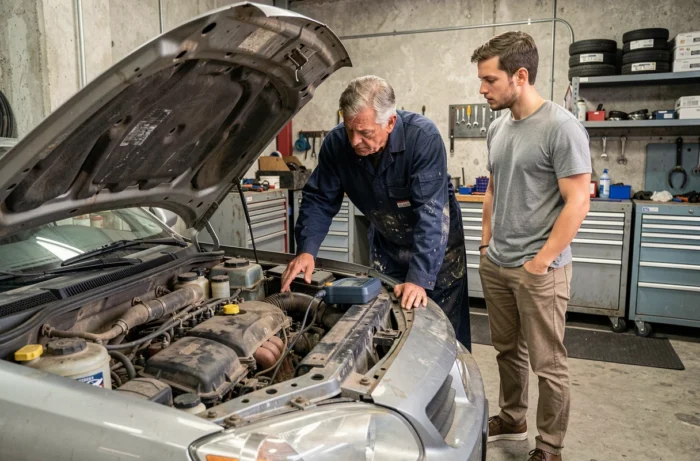
If the financial stakes justify it, having an independent mechanic inspect the vehicle before you sign is still the most cost-effective precaution. The inspection costs a fraction of an unexpected repair.
The used-car market remains very active, which means another listing will always come along if an interesting one sells. Comparing several similar vehicles before signing is a better safeguard than driving a hard bargain on a single car. In this market, patience is part of the budget.


