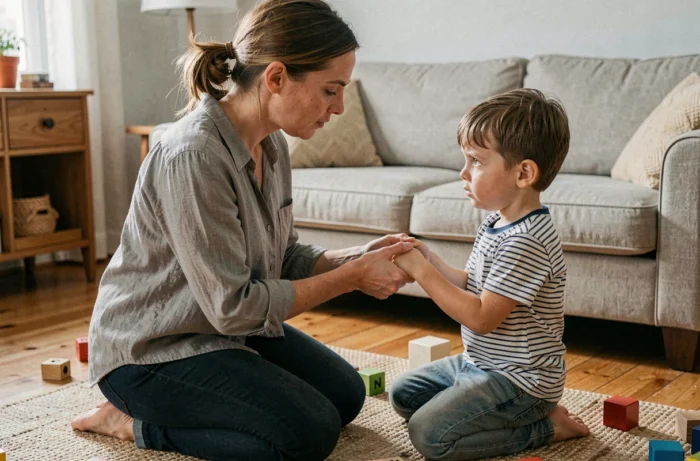
A child who runs around, knocks over their glass, interrupts others or refuses to sit down does not necessarily have a behavioral problem. Turbulence in children refers to a range of restless, impulsive or defiant behaviors that go beyond what an adult expects in a given situation. Responding to these behaviors with kindness means understanding what they are expressing before trying to stop them.
Temporary restlessness or persistent behavior: what to look for
All children go through restless phases. A move, the arrival of a younger sibling, a change of teacher or simply a growth spurt can trigger several weeks of challenging behavior. Temporary restlessness fades as its cause subsides.
The warning sign is not the intensity of a single outburst, but its frequency and duration. Behavior that persists for more than six months, occurs in several settings (home, school, extracurricular activities) and interferes with learning or social relationships is worth discussing with a healthcare professional.
- Frequency: daily or near-daily outbursts over several months go beyond the normal restlessness associated with a child’s age.
- Context: a child who is restless only at home presents a different picture from one who is agitated everywhere, all the time.
- Functional impact: difficulty making friends, declining school performance or chronic parental exhaustion are concrete indicators.
The key is to observe without labeling. Talking too quickly about attention deficit or hyperactivity can shape how a child sees themselves. On the other hand, consistently downplaying concerns can delay helpful support. A family doctor or school doctor is the first person to consult and can refer the child for a psychological or psychomotor assessment if needed.
Resources dedicated to positive parenting, such as https://www.lesterriblesenfants.be, offer guidance to families who have questions about their children’s behavior.

Setting boundaries without punishment: structure as a source of security
Clear boundaries reassure a restless child more than they restrict them. A lack of limits creates anxiety, as the child repeatedly tests boundaries to find out where to stop. Being kind does not mean allowing everything: it means explaining rules in a way the child can understand and enforcing them consistently.
Give instructions a child can follow
Effective instructions are brief, specific and phrased positively. “We walk in the hallway” works better than “Stop running” because it tells the child what to do rather than what behavior to suppress. A three- to six-year-old’s brain has difficulty processing negation under stress.
Keeping the number of active rules low also helps. Three or four non-negotiable rules (such as physical safety and respecting other people’s bodies) are more effective than a list of twenty prohibitions that no one can remember.
Enforce the rule without escalating
When a child breaks a rule, it helps for the adult to respond matter-of-factly. Describe what happened (“You threw the toy and it hit your sister”), then restate the rule (“We don’t throw things at people”). In most cases, that’s enough. Adding a logical consequence, such as temporarily taking the toy away, reinforces the boundary without humiliating the child.
Shouting or threatening may have an immediate effect, but it creates a cycle in which the child needs increasingly strong reactions to stop. The WHO emphasizes the importance of parental support based on evidence-based approaches that are accessible to families, rather than punitive practices.
Acknowledge a restless child’s anger without dismissing it
A child’s anger is not a tantrum for no reason. It is an emotion that signals frustration, fatigue or an unmet need. Acknowledging the emotion does not mean approving of the behavior: you can recognize the anger while refusing to accept the action that comes with it.
Naming the emotion out loud (“I can see that you’re very angry”) helps the child identify what they are feeling. Putting feelings into words activates the brain’s prefrontal regions, which regulate impulsivity. With practice, children learn to use words instead of screams or hitting.
Offer a physical outlet
A child in the middle of an outburst needs to release physical tension. Hitting a cushion, running in the garden or squeezing a soft ball are acceptable ways to let off steam. The goal is not to eliminate the emotion, but to give it an outlet that doesn’t hurt anyone.
Waiting for the outburst to subside before talking is more effective than trying to reason with an overwhelmed child. A constructive conversation is best held once cortisol levels have fallen, sometimes twenty to thirty minutes after the emotional peak.

Consistency between adults: an often-overlooked factor
Children quickly notice differences in how the adults around them respond. If one parent gives in after five minutes of screaming while the other holds firm, the child will naturally intensify their attempts. Consistency between adults measurably reduces the frequency of outbursts after a few weeks.
This consistency also applies between home and school. Regularly discussing shared rules, the words used and strategies for calming down with the teacher helps children find stable cues in different settings.
Disagreements about parenting should be resolved away from the child. Debating a rule in front of them shows that boundaries are negotiable, which fuels restlessness rather than containing it.
Supporting a restless child takes time and tests your patience. The most useful first step is to observe how long the behavior lasts, where it occurs and how it affects daily life before reacting. A child who vigorously tests boundaries is often trying, in their own clumsy way, to understand how the world around them works.


