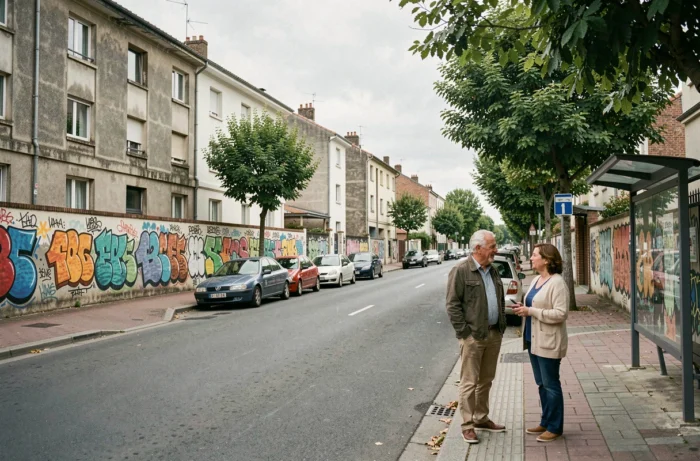
La Paillade is the most populous neighborhood in western Montpellier. Built in the 1960s under the direction of architect Edouard Gallix, it was designed as a priority urban development zone to accommodate Montpellier’s population growth.
Its reputation, often reduced to news stories reported by the media, masks a more complex reality: an urban renewal program worth more than 500 million euros is underway in the Mosson and Les Cévennes areas, and the first completed facilities are beginning to change everyday life in the neighborhood.
Pailleron schools in La Paillade: replacement as a marker of change
Most articles about La Paillade discuss urban renewal through the lens of housing or safety. The schools tell a different, more tangible story.
Ten former Pailleron-style schools—metal-frame buildings constructed in haste during the 1960s and 1970s—are scheduled to be replaced in the neighborhood. Two projects have already been completed: Hypatie School, which opened in September 2025, and Hélène Mandroux-Yvette Roudy School, inaugurated in November 2026. The latter brings four aging schools together on a single site.
These new buildings are presented as a response to the challenge of thermal comfort during heatwaves. With their lightweight façades and virtually nonexistent insulation, the old Pailleron buildings made classrooms difficult to bear as early as June. For families already living in La Paillade, these schools represent a tangible improvement in their children’s school environment.
A detailed article about the La Paillade neighborhood in Montpellier helps illustrate the gap between outsiders’ perceptions of the area and these concrete investments in education.
Tram line 5 and the real accessibility of the Mosson neighborhood
The arrival of tram line 5 has changed how people get around La Paillade. Before this service was introduced, the neighborhood relied mainly on line 1 and bus routes whose frequency remained irregular in the evenings and on weekends.
The new line improves connections to other parts of Montpellier. What remains unclear, however, is the actual travel time for residents commuting to employment areas east of the metropolitan area or to outlying shopping districts. No available source provides a precise estimate of the time saved on these daily journeys.
The question remains: does the tram service benefit current residents as much as students at the nearby campus and visitors passing through the neighborhood? The university campus on Route de Mende and Mosson’s sports facilities generate through-traffic that does not reflect the mobility needs of local families.
Redevelopment of public spaces in La Paillade: who benefits?
Several areas around the new Hélène Mandroux-Yvette Roudy School have been transformed, including the school forecourt, Place Gisèle-Halimi, and nearby streets. The project aims to reduce the space given to cars around the school.
This type of redevelopment raises a practical question for residents. In a neighborhood where some people work irregular hours in cleaning, logistics, and food service, reduced parking and pedestrianization do not always fit their actual travel needs. Families who drop their children off by car before heading to an employment area poorly served by public transport may sometimes find these changes add another complication.
The transformation of public spaces improves the neighborhood’s appearance and pedestrian safety. The impact on residents’ daily lives depends on factors that redevelopment alone cannot address:
- Residential parking, already insufficient around the apartment blocks built in the 1960s, is not being supplemented by the projects underway
- Local shops remain less diverse than those in central Montpellier, leaving residents dependent on cars for specialty grocery shopping
- Public services (CAF, Pôle emploi, specialist healthcare services) remain concentrated in the city center, limiting the impact of local pedestrianization on the neighborhood’s self-sufficiency
Cultural life and La Paillade’s media image
The neighborhood has its own cultural initiatives, often overlooked by mainstream media. Kaina Médias, a local media outlet based in La Paillade, has been documenting neighborhood life for several years. Outdoor exhibitions organized by young residents, such as those featured on YouTube, showcase cultural activity driven by residents themselves.
In 2024, the Montpellier Culture Facebook group shared news of the CFA sanitary and social care training center opening on the Paillade campus, a sign that the neighborhood is also attracting vocational training programs. This new presence is gradually changing the profile of people using the area, with a steady flow of work-study students visiting local shops and using public transport.
Yet La Paillade’s media image remains dominated by news stories. Montpellier’s municipal archives hold more than 79 articles and 200 plans related to Edouard Gallix’s work in the neighborhood—a piece of architectural heritage that features on no tourist route and in no visible institutional communications.
La Paillade’s reputation: what is changing—and what is not
The urban renewal program underway is the most ambitious the neighborhood has seen since it was built. New schools, the tram line, and redesigned public spaces are transforming the built environment. These investments are changing the surroundings without guaranteeing that current residents will benefit proportionately.
A neighborhood’s reputation is not built on ribbon-cutting ceremonies. It is built on the everyday experiences of the people who live there: how long it takes to get to work, how hot their apartment gets in August, and whether there is a family doctor within a ten-minute walk. By these measures, the verdict is still out, and it will take several years to reach one.


