Going down four floors with a stroller that gets stuck in the stairwell, then crossing three streets without a safe pedestrian crossing to reach the nearest park: this is the real-life test that Paris imposes from the very first months. Living in Paris with children works, but every logistical detail matters, from the choice of neighborhood to public transport rules.
Strollers on the metro and bus: what RATP rules really allow
Competitors often talk a lot about neighborhoods and green spaces, but rarely about the constraints of daily travel. Yet, we spend more time on public transport than at the park.
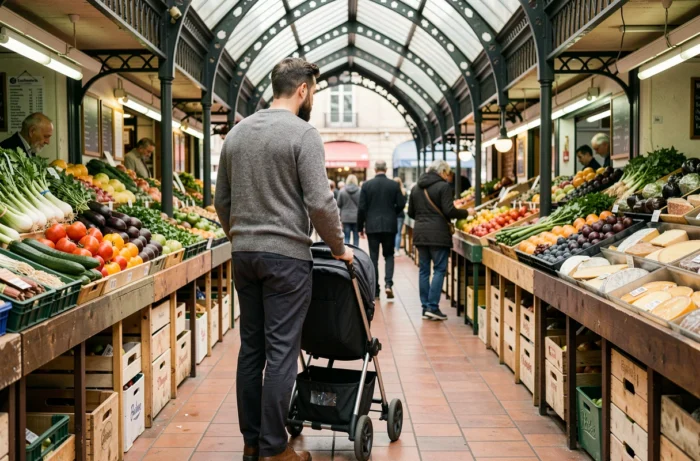
In the metro and RER, strollers are allowed but preferably folded according to the RATP reference document. In practice, folding a stroller loaded with a diaper bag while holding a child in your arms is quite an achievement during peak hours.
For buses, the rule differs: up to two unfolded strollers are allowed in a standard or articulated bus, with the driver’s agreement. The bus thus becomes the most practical mode of transport for parents of young children, provided they identify the lines that serve daycare, school, and home.
Many Parisian families end up organizing their trips around bus lines rather than the metro. Numerous practical resources for parents moving to or already living in the capital can be found at https://www.mamanaparis.fr/.
Daycare spots in Paris: an allocation system that varies by arrondissement
The satisfaction rate for municipal daycare requests hovers around one in four citywide. Seven out of ten families do not get a spot. This overall figure masks significant disparities from one arrondissement to another.
The 10th arrondissement, for example, has been publishing a documented allocation system since 2023 in its early childhood guide (2026-2027 edition). This guide details ranking criteria and local resources for parenting support. Not all arrondissements make this effort for transparency.
Planning from pregnancy
Submit your application as early as possible, ideally by the sixth month of pregnancy. Each arrondissement’s town hall manages its own list, and applying in multiple arrondissements is not prohibited if you are still undecided about the neighborhood.
Alternatives exist: associative daycares, private micro-daycares, childminders. Costs vary significantly depending on the structure. For households with intermediate incomes, childcare can weigh disproportionately on the budget, even after CAF assistance.
Air quality and lead in schools: what the Paris environmental health plan changes
The Paris environmental health plan adopted in November 2024 directly targets establishments welcoming children. Two main areas concern parents daily:
- Indoor air quality in daycares and schools is subject to specific actions, with scheduled measurements and ventilation work
- Exposure to lead in old school buildings is included in the plan, a topic that has long remained under the radar in some central arrondissements
- The City indicates it reached its goal of organic and sustainable food in daycares by the end of 2024, which directly concerns the nutrition of toddlers
These advancements do not solve everything. Implementation depends on the budgets allocated by arrondissement, and work in the oldest schools takes time. You can check with the arrondissement town hall if the targeted school is among the priority establishments.

School streets and green spaces: choosing a neighborhood suitable for family life
School streets, these roads closed to traffic during school entry and exit times, have multiplied in recent years. They are no longer limited to road adjustments: some are becoming spaces for activities and local participation, with workshops organized by neighborhood associations.
When choosing a neighborhood, proximity to a park is prioritized over proximity to a monument. Paris has over 500 public parks and gardens, in addition to the Bois de Boulogne and the Bois de Vincennes. The distribution remains uneven: peripheral arrondissements (12th, 15th, 16th, 17th) offer significantly more green space per inhabitant than the center.
Three concrete criteria before signing a family lease
- The walking distance between the home and the local school (school map available at the arrondissement town hall), considering the actual route and not the straight-line distance
- The presence of a square or park within ten minutes’ walk with a child, which radically changes daily life after 4:30 PM
- Access to a direct bus line to the workplace, more reliable than a metro trip with a transfer when you have a stroller
The right family neighborhood in Paris is not the most prestigious, but the one where daily logistics work smoothly. A larger apartment in a less sought-after arrondissement, with an accessible park and a school five minutes away, is often better than a central two-room apartment where every outing becomes an expedition.