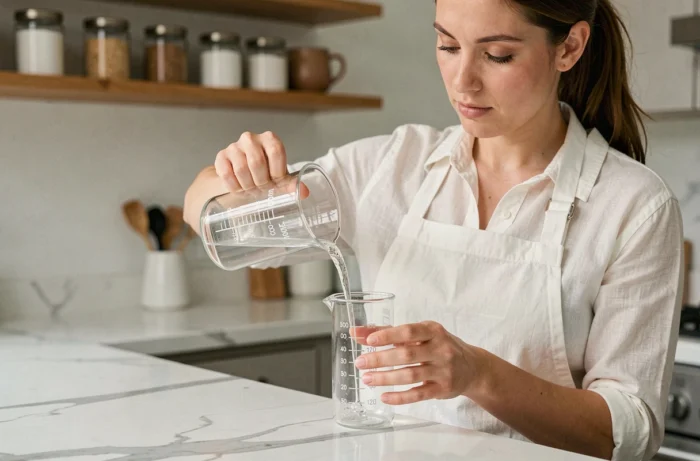
Converting 200 ml to cl means dividing by 10. The result is 20 cl, and this equivalence remains the same regardless of the liquid being measured. The conversion applies to volume, not mass: 200 ml of oil and 200 ml of water take up the same space, even though they weigh different amounts.
Conversion table from ml to cl for common cooking volumes
| Millilitres (ml) | Centilitres (cl) | Litres (l) |
|---|---|---|
| 50 ml | 5 cl | 0,05 l |
| 100 ml | 10 cl | 0,1 l |
| 150 ml | 15 cl | 0,15 l |
| 200 ml | 20 cl | 0,2 l |
| 250 ml | 25 cl | 0,25 l |
| 330 ml | 33 cl | 0,33 l |
| 500 ml | 50 cl | 0,5 l |
| 750 ml | 75 cl | 0,75 l |
| 1 000 ml | 100 cl | 1 l |
The “litres” column helps you relate these measurements to the capacities shown on store-bought bottles. A 200 ml carton of soup is equivalent to 20 cl, or 0,2 l. Knowing how to convert 200 ml to cl comes down to one simple operation: divide the value in millilitres by 10.
A millilitre is also equivalent to a cubic centimetre (cm³). In other words, 200 ml takes up a volume of 200 cm³ in any container.
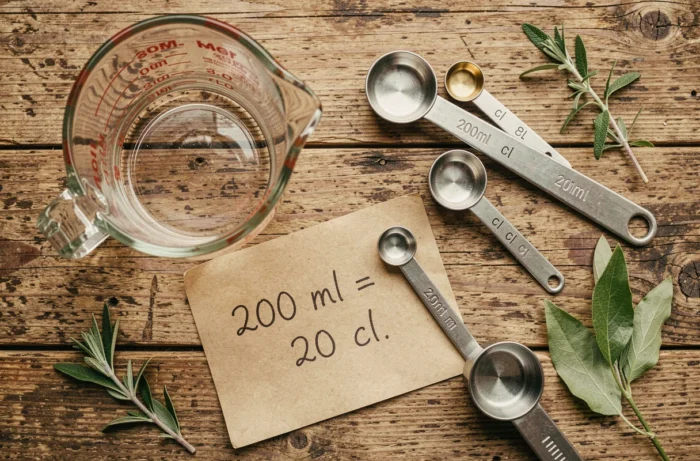
Conversion formula between millilitres and centilitres
The relationship between these two units of volume is fixed. It does not depend on the ingredient, temperature or density.
From ml to cl
cl = ml ÷ 10. For 200 ml: 200 ÷ 10 = 20 cl.
From cl to ml
ml = cl × 10. For 20 cl: 20 × 10 = 200 ml.
The factor of 10 comes from the metric system’s prefixes themselves. “Centi” means one hundredth of a litre (1 l = 100 cl), while “milli” means one thousandth of a litre (1 l = 1 000 ml). The ratio between the two is therefore always 10.
Volume and mass: why 200 ml does not always weigh 200 g
The most common mistake is treating millilitres as grams. This equivalence only applies to pure water, whose density is close to 1 g/ml under typical conditions.
The difference becomes clear as soon as you use another liquid. 200 ml of olive oil weighs less than 200 ml of water because oil is less dense. Conversely, 200 ml of honey weighs considerably more.
- 200 ml of water = 20 cl and approximately 200 g, the only case where volume and mass correspond directly.
- 200 ml of oil = 20 cl, but it weighs less than 200 g because it is less dense.
- 200 ml of whole milk = 20 cl, and weighs slightly more than 200 g because milk is a little denser than water.
When converting volume, the result is always 20 cl for 200 ml. The distinction between volume and mass only matters for recipes that specify grams instead of millilitres.

Measuring 200 ml without a measuring cup marked in ml
A kitchen measuring cup marked in centilitres will do: simply find the 20 cl mark. To get an accurate reading, place the container on a flat surface and check the liquid level at eye height. The surface of the liquid forms a slight curve (the meniscus); the bottom of this curve indicates the actual volume.
Measuring cup markings are not always fine enough to distinguish small differences around a given amount. A measuring cup marked in 10 cl increments lets you measure 20 cl, but not down to the nearest millilitre. For very precise measurements, choosing the right container matters just as much as the conversion itself.
Digital kitchen scales are a useful alternative when measuring water. Since water’s density is close to 1 g/ml, weighing 200 g is equivalent to measuring 200 ml, or 20 cl. This trick does not work for other liquids, which have different densities.
Measurements using common kitchen utensils
- A tablespoon holds about 15 ml. You would need a little over 13 tablespoons to reach 200 ml, which is not very practical.
- A standard drinking glass often holds around 20 to 25 cl. Filling a 20 cl glass to the brim gives you approximately 200 ml.
- Bar measures, marked directly in centilitres, are designed for precise portions and can eliminate the need for conversions when making cocktails.
Common conversion mistakes with units of volume
Confusing cl and ml in a recipe means multiplying or dividing an amount by 10. Adding 200 cl of cream instead of 200 ml means pouring 2 litres into the mixture.
International recipes can also be tricky. Anglo-Saxon measurements use cups, fluid ounces and tablespoons, which do not correspond directly to millilitres or centilitres. 200 ml is not exactly one US cup: a standard cup is equivalent to about 237 ml. Rounding without checking the conversion can throw off the measurements, especially in baking.
The most reliable approach is to convert everything to a single unit before starting a recipe. If your measuring cup shows centilitres, converting all the measurements to cl as you read the recipe avoids switching back and forth between units and helps prevent measuring errors.
Remembering that 200 ml equals 20 cl thanks to the metric system’s factor of 10 saves time every time you cook. This rule applies to all volumes in ml, with no exceptions or special conditions.


